


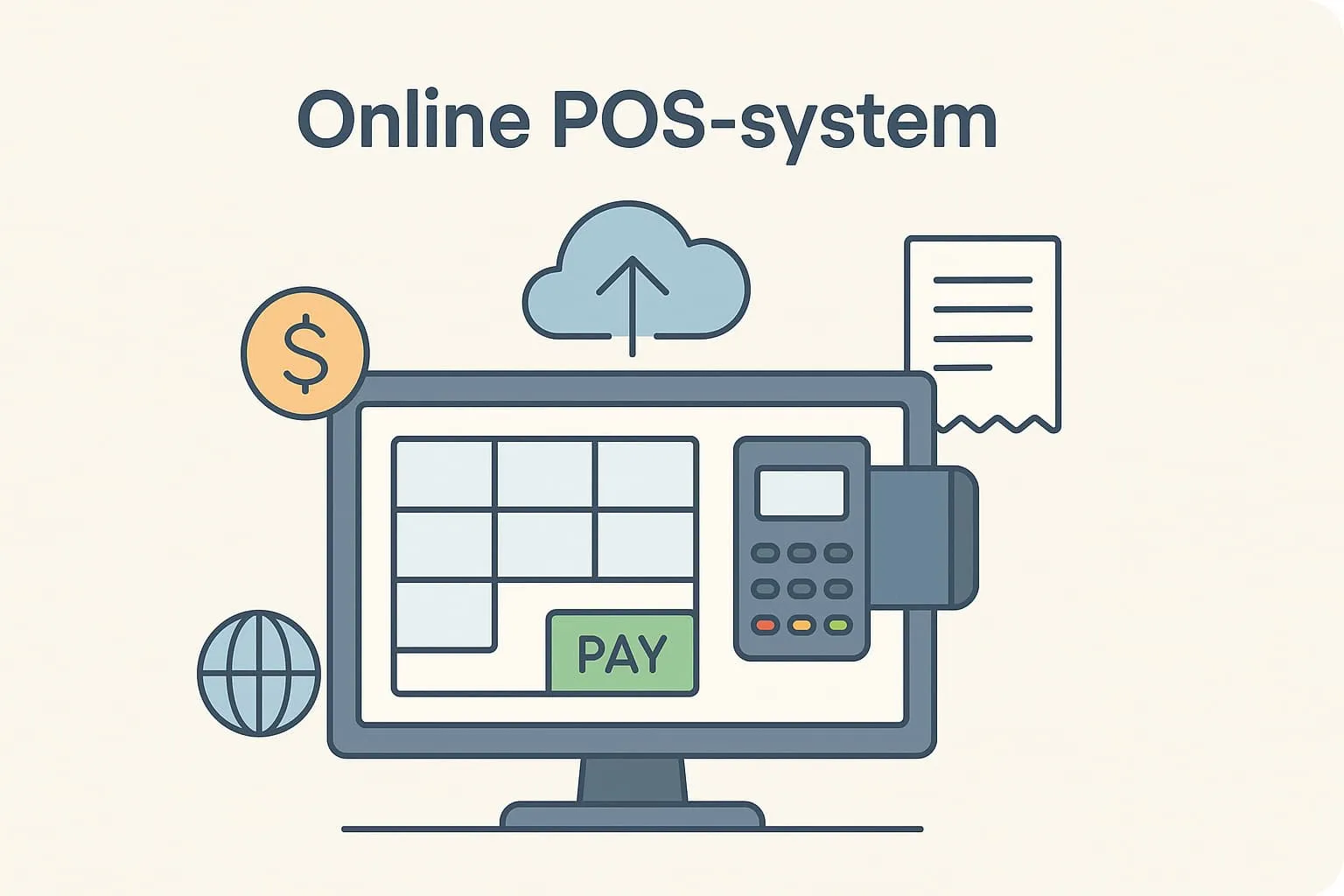
An online POS system (Point of Sale) is a cash register system connected to the cloud that works over an internet connection. Unlike traditional, local systems, an online POS system stores all data digitally, giving access to sales and operational information from several devices and locations – in real time. As a restaurant or café owner, you can monitor and run your business even when you are not physically there.
In practice, all sales data, stock levels and customer transactions are synchronised automatically. You can quickly see today’s revenue, update menus, change prices and analyse sales statistics – all without being tied to a specific physical terminal.
A concrete example: A café with table service, takeaway and online ordering
Picture a café with 40 seats, a takeaway counter and ordering through its own website. Before, the café used one till at the counter, a separate solution for online orders and a spreadsheet for stock. In the mornings, that meant queues, double entry and pastries selling out without warning.
With an online POS, a busy morning looks like this:
- A customer orders coffee and a croissant on the website at 8:15 and pays with Apple Pay. The order lands in the POS system straight away.
- The order appears on the screen behind the counter with a pick-up time, so the barista can have it ready.
- At the tables, the waiter takes orders on a tablet. Food goes straight to the kitchen, drinks to the bar.
- When the last croissant is sold, it is marked as sold out both at the till and on the website.
- The owner sees revenue split by table service, takeaway and online on their phone – and can see that oat milk needs reordering.
That means fewer manual entries, shorter morning queues and one overview of all sales channels. The same principle applies to restaurants with table booking and delivery orders.
It is important to know the term “online POS system”, because it is increasingly the standard in modern restaurant ownership. With the right solution, you not only streamline operations but also minimise errors, reduce manual registration and save time every day. You also get access to data that makes business decisions easier.
Online POS systems in 2026: an example from Denmark
- In Denmark, over 90% of all payments are digital. Cash made up only 9% of payments in physical retail in 2025, compared with 23% in 2017 (Danmarks Nationalbank, June 2026).
- One in three card payments is made with a phone. 31.6% of Danes’ 2,863 million card transactions in 2025 went through digital wallets such as Apple Pay and Google Pay, up from 28.0% in 2024 (Danmarks Nationalbank, Feb. 2026).
- Danish card turnover grew 5.9% in 2025 (Danmarks Nationalbank, Feb. 2026). Your online POS system must therefore work seamlessly with terminals and wallets.
- Outages happen – offline operation is a must. In Denmark, the card processor Nets had technical outages in July 2025 and May 2026 (Danmarks Nationalbank). Choose an online POS system that can keep selling without a connection.
- Rules on digital bookkeeping are tightening. In Denmark, for example, more sole proprietorships and associations must keep their books digitally from 1 January 2026 (PwC). Rules differ per country, but an online POS system that sends sales data directly to the accounting software makes such requirements easier to meet.
How Flexybox uses the term in practice
Flexybox offers an online POS system that connects sales data from both physical tills and online orders. Your data is always synchronised, wherever the sale happens. You can easily follow developments across platforms, adjust your range and analyse customer behaviour based on up-to-date information. That means you always have the overview – and can act quickly when needed. Read more here: FlexyPOS, our online POS system
Read also:
What is a POS system
What is a payment gateway
Frequently asked questions
A traditional POS system is installed locally and requires you to be physically present at the till. An online POS system runs in the cloud and gives access to your store data from any internet-connected device.
Yes, but most systems – such as Flexybox – have offline features, so you can still complete sales if the internet temporarily goes down.
Yes. When you use a professional solution like Flexybox, your data is stored securely on encrypted servers that are continuously monitored and updated.
Yes. Most online POS systems can be adapted to your needs – for example setting up menus, adding discounts, managing stock and integrating with online orders.