


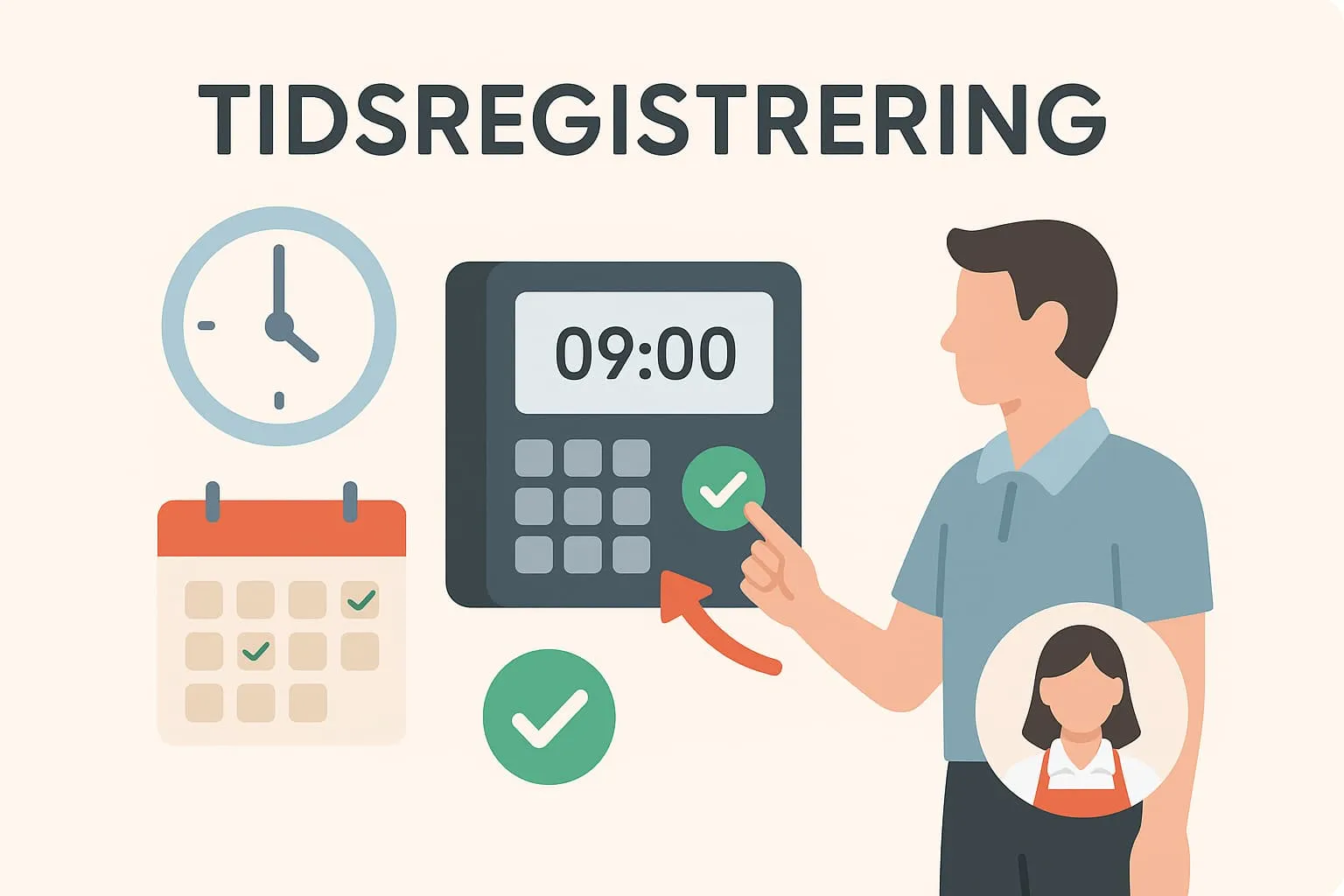
What is time tracking?
Time tracking is the process of recording employees’ working hours – when they arrive, take breaks and go home. In restaurants, cafés and bars, where many employees work in shifts, at unsocial hours and often part-time, accurate time tracking is essential for smooth operations. Recording all hours correctly ensures employees get the right pay and that overtime or undertime is spotted. It also helps document compliance with working time rules and any collective agreements.
In the past, time tracking was typically done with paper forms or time clocks, where employees physically wrote down or punched their hours. Today, it is usually digital – for example via a POS system or an online time tracking system. With a digital solution, staff “clock” in and out on a screen, terminal or app, which gives accurate data in real time. This reduces both time spent and manual errors compared with old-fashioned timesheets, because everything is recorded automatically and can be stored securely in the cloud. Both managers and employees can easily access the records, creating transparency and trust around working hours.
An example from the restaurant
Picture a busy café-restaurant with eight employees spread across different shifts during the day. When the morning team arrives, they log their attendance directly on the POS touchscreen at the counter. Later in the day, when some go on break and others arrive for the afternoon or evening shift, they do the same – checking in and out via the system each time their status changes. If an employee is late or forgets to clock in, the manager can quickly see it in the system and follow up. At the end of the shift, staff register their clock-out. All this means the manager has a real-time overview all day of who is at work and when they arrived or left.
As well as giving an overview, the system automatically generates a report of the day’s (and week’s) recorded hours. The manager can easily see how many hours each employee has worked and whether anyone has had overtime or undertime. Any overtime hours are clearly shown, so they can be paid correctly or taken as time off later. In short, the café’s management no longer has to collect timesheets manually – instead, all data is recorded correctly and ready for payroll.
Why is time tracking important in a POS system?
When time tracking is integrated into your POS system, it creates efficiency gains and minimises errors. First, sales data and working hours are linked, so you can follow in real time how labour costs develop relative to revenue. This gives valuable insight: if the labour cost percentage suddenly rises on a quiet morning, you can react by adjusting staffing – conversely, if the café gets busy and revenue rises, you can see the need for extra staff straight away. Linking this data helps restaurant managers make better decisions about staffing and budget.
A digital time tracking system also eliminates many of the errors that can arise with manual recording. Because employees’ hours are logged automatically in the system, you avoid misunderstandings or incorrect entries that can lead to wrong pay. The system also ensures transparency: both management and employees can see the recorded hours at any time, reducing the risk of disagreement about the figures. At the same time, you have solid documentation of compliance with working time rules – something that has become even more important as countries such as Denmark (in 2024) have introduced requirements to record working hours. In short, integrated time tracking saves admin time and ensures correct staff management without extra hassle.
How does Flexybox support time tracking?
Flexybox’ POS system and booking system have time tracking built in as a natural part of the platform. Your employees can register clocking in and out in the same place where they handle orders and reservations. In practice, staff can log in with a personal code or tag on a tablet, terminal or computer – for example the screen at the till they use every day anyway. Every time someone arrives, takes a break or finishes their shift, it is recorded accurately in the system.
For you as an owner or manager, Flexybox gives a full overview of staff attendance in real time. You can see who is at work right now and when the different employees arrived or went home. The system automatically compiles the hours and prepares them for payroll – you can easily export the recorded working hours to your payroll system, so wages are calculated correctly without manual entry. Because everything is digital, you avoid paperwork and manual typing errors. The Flexybox system also supports different pay rules (for example overtime pay or supplements for evening/weekend work), so all employees are paid in line with their working hours. In short, Flexybox helps make time tracking easy, automated and reliable – saving you time and ensuring you always have control of your staff resources.
Read also:
Frequently asked questions
Are time tracking and time registration the same?
The terms are often used interchangeably, but there is a small difference in focus. Time tracking is a broader term covering the recording of all work-related time – including start times, breaks and any project hours. Time registration, on the other hand, typically focuses only on the working time itself (the number of hours worked). In practice, the two terms overlap a lot, especially in the hospitality industry, and most time tracking systems also handle time registration.
Yes, the recorded working hours can be exported directly to your payroll system, which reduces errors and makes payroll administration faster and easier.
Absolutely. With a modern time tracking system, staff can handle clocking in and out themselves. In Flexybox, for example, each employee has their own login code, which they enter on the screen to check in at the start of the shift and out again at the end. Their working hours are recorded continuously without a manager having to do it manually. It is user-friendly for employees and saves management time.
In Flexybox, an administrator can manually correct or add records, so there is always correct data for payroll and documentation.
In many countries, yes. Under EU law, as interpreted by the EU Court of Justice in 2019, employers must have a system for recording employees' working time, and each country implements this in its own rules. In Denmark, for example, a duty to register working time has applied to all employers since 1 July 2024. Rules differ by country, so check what applies where you employ staff. A digital solution makes it much easier to meet such requirements and avoid errors.
By automating time tracking linked to the POS system, Flexybox saves you a lot of manual steps in administration. Employees’ hours are recorded automatically and don’t need to be entered into an external system afterwards – everything is already digital and ready for payroll. This minimises the risk of typing errors and ensures the payroll basis is always correct. The system also gives an overview of rotas, breaks and working hours, so you can plan staffing more easily and react if your needs fluctuate. All in all, it frees up time for you as managers to spend on other parts of the business, while you can be confident that employees’ pay and working hours are handled efficiently and correctly.